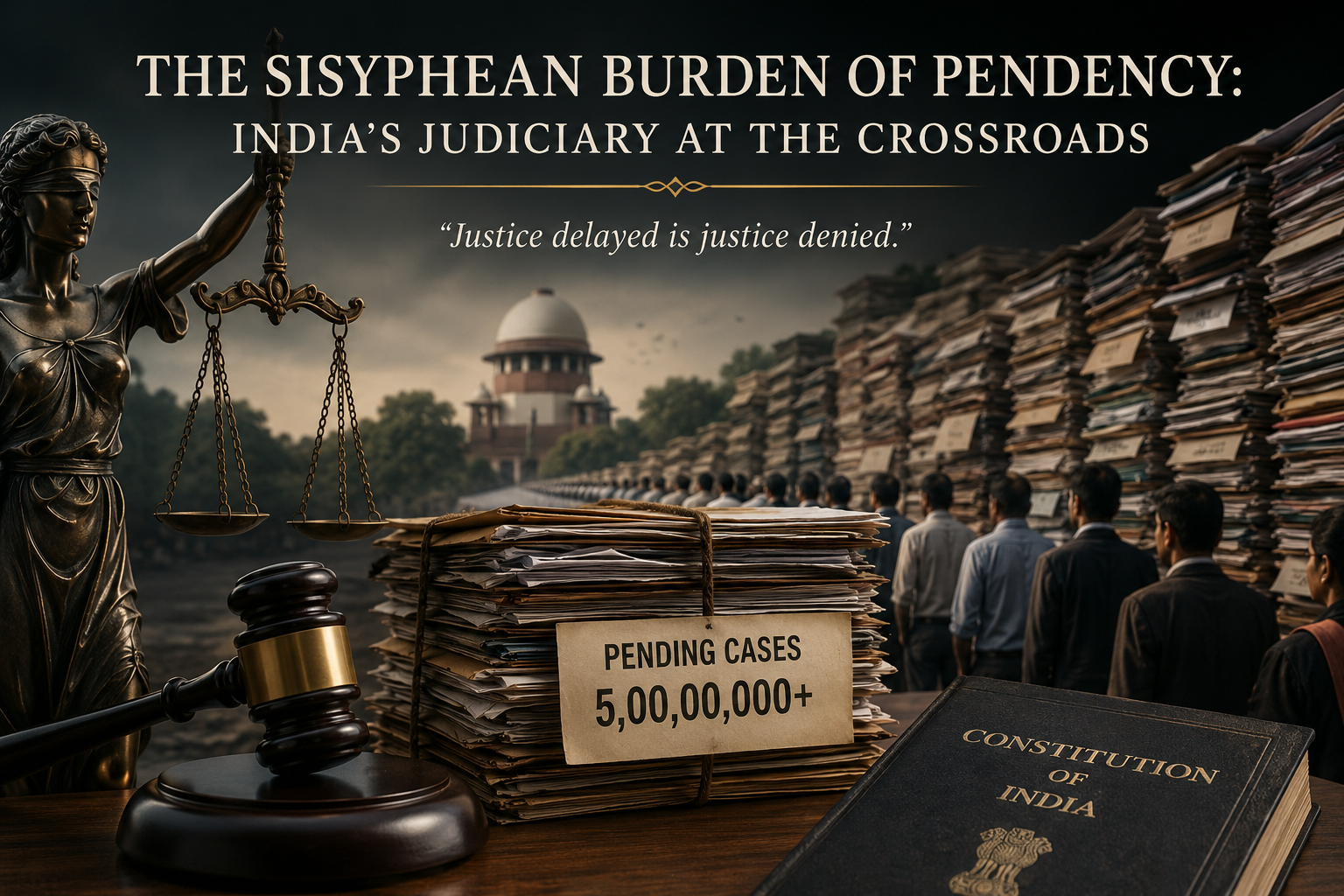
There are moments in the life of a constitutional democracy when statistics cease to be mere numbers and metamorphose into a solemn indictment of institutional capacity. India’s judicial pendency has now crossed the staggering threshold of five crore cases. Such a figure is not merely an administrative concern; it is an existential challenge to the promise of justice enshrined in our Constitution.
Every pending matter represents more than a file gathering dust in a courtroom. It is a grieving family awaiting closure, an entrepreneur deprived of commercial certainty, an undertrial suspended in the limbo of prolonged incarceration, or a citizen whose faith in the majesty of law is progressively eroded by the inexorable march of time. The true tragedy of judicial delay lies not in the arithmetic of backlog but in its profoundly human consequences.
The often quoted maxim, “Justice delayed is justice denied,” has perhaps never resonated with greater poignancy.
A Crisis Decades in the Making
It would be intellectually facile, and demonstrably inaccurate, to attribute this predicament solely to judicial inefficiency. The malaise is structural, cumulative, and the consequence of decades of institutional neglect.
India continues to labour under a conspicuously inadequate ratio of judges available according to the population, one that compares unfavourably with most mature democracies. Even more disconcerting is the persistence of vacancies across constitutional and subordinate courts, compelling an already overburdened judiciary to shoulder an ever-expanding docket with manifestly insufficient human resources.
One cannot reasonably expect an institution to perform Herculean feats while denying it the necessary musculature.
The paradox is striking. As India’s economy has expanded, commercial transactions have multiplied, regulatory frameworks have proliferated, and constitutional consciousness has deepened, litigation has inevitably burgeoned. Yet the architecture of justice delivery has scarcely kept pace with this societal transformation.
The Government: The Reluctant Litigant That Never Relents
An often-overlooked dimension of the crisis is the State’s own contribution to the avalanche of litigation. Governments remain among the largest litigants in the country, frequently pursuing appeals even where legal principles stand authoritatively settled. This culture of reflexive litigation exacts an enormous institutional cost, consuming scarce judicial time that could otherwise be devoted to genuinely contentious disputes.
A litigation policy informed by prudence rather than bureaucratic inertia would itself constitute a significant reform.
Procedure as Both Shield and Shackles
Procedural safeguards are the indispensable guardians of fairness. Yet procedures, when allowed to ossify into ritualistic formalism, can inadvertently become impediments to justice itself.
Repeated adjournments, delayed investigations, cumbersome service of process, witness non-appearance, and protracted interlocutory skirmishes collectively transform litigation into an endurance contest rather than a quest for justice. Law must remain an instrument of justice, not a labyrinth from which litigants emerge exhausted.
The Invisible Cost of Delay
The consequences of judicial pendency cannot be measured merely by annual disposal statistics.
A civil decree delivered after two decades may vindicate a legal right but fail to restore the years irretrievably lost. Criminal prosecutions prolonged beyond reasonable limits diminish evidentiary reliability, inflict avoidable suffering upon victims, and subject accused persons to prolonged uncertainty inconsistent with the constitutional guarantee of personal liberty.
Commercial disputes languishing in courtrooms impede investment, discourage entrepreneurship, and inflate the cost of doing business. The economic ramifications of delayed justice ripple far beyond the courtroom, subtly but significantly constraining national growth.
Most perilously, persistent delay corrodes public confidence in the rule of law itself. Institutions derive legitimacy not merely from constitutional text but from the confidence they inspire among those they serve.
Reform Must Be Comprehensive, Not Cosmetic
There exists no panacea. Filling judicial vacancies with expedition is indispensable but insufficient. Increasing sanctioned judicial strength, augmenting courtroom infrastructure, strengthening administrative support, and modernising court management systems are equally imperative.
Technology offers an unprecedented opportunity to reimagine judicial administration. Intelligent case management, comprehensive digitisation, electronic filing, AI-assisted research tools, and virtual hearings where appropriate can substantially enhance efficiency without compromising procedural fairness.
Equally deserving of renewed emphasis is the ecosystem of Alternative Dispute Resolution. Mediation, arbitration, and Lok Adalats should no longer be viewed as peripheral mechanisms but as indispensable pillars of an efficient justice delivery architecture. Every dispute amicably resolved outside the courtroom is one less burden upon an already strained judicial system.
Yet reform cannot be the judiciary’s burden alone. Governments must litigate more responsibly. Lawyers must resist the temptation of unnecessary adjournments. Litigants must embrace consensual dispute resolution wherever feasible. Institutional renewal is a collective enterprise.
Beyond the Numbers
It is fashionable to lament judicial pendency, but considerably less fashionable to acknowledge the extraordinary resilience of those who labour within the system. Despite constrained resources, India’s judges dispose of an astonishing number of cases every year, often under conditions that would challenge the capacities of any comparable institution.
The crisis, therefore, is not one of commitment but of capacity. A constitutional democracy cannot afford a justice delivery system perpetually racing to outrun its own backlog. The judiciary is not merely another organ of governance; it is the sentinel of constitutional liberties, the arbiter of civilised disagreement, and the final refuge of the citizen against arbitrariness.
If justice is the lifeblood of the Republic, then timely justice is its circulation. For a nation that aspires to global leadership in the twenty-first century, ensuring that justice is not merely available but accessible within a reasonable time is not an administrative aspiration and rather it is a constitutional obligation, a democratic necessity, and, above all, a moral imperative.