
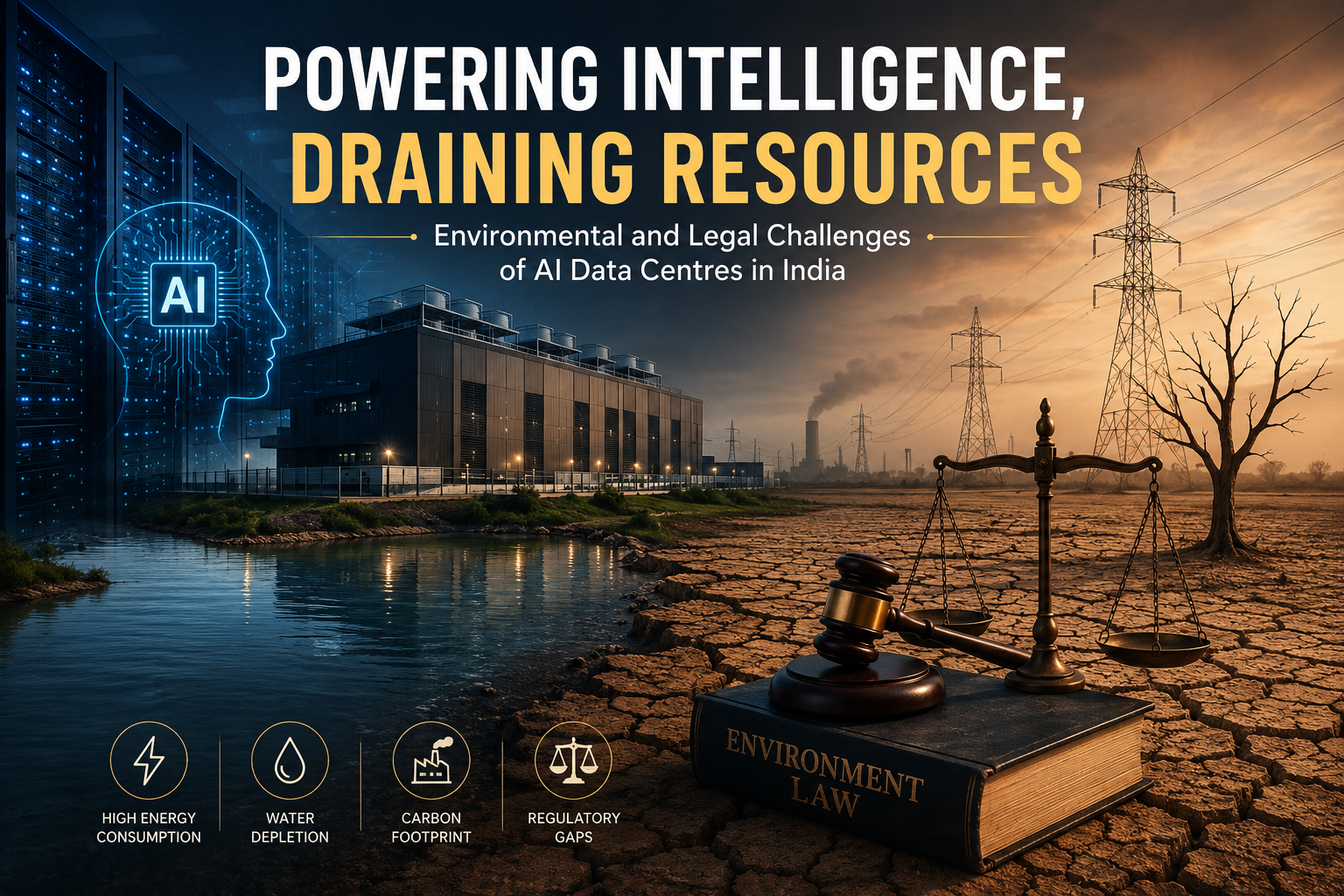
The global digital landscape is currently undergoing a paradigm shift driven by the rapid advent and integration of artificial intelligence into nearly every sector of public and private life. While artificial intelligence offers transformative potential for education, medicine, and industrial efficiency, it rests upon a massive, resource-intensive physical infrastructure, namely the data center. Often described as the "brains" of the digital economy, data centers are becoming the focal point of a burgeoning conflict between technological advancement and environmental stewardship.
Behind every AI-generated response or trained model lies an extraordinary environmental footprint. Training a single large language model (LLM) can generate carbon emissions equivalent to hundreds of round-trip flights between major global cities. India's installed data centre capacity is estimated at around 1.2 GW in 2025. While government discussions have suggested a possible expansion to as much as 15–17 GW by 2030, most industry forecasts estimate between 4 and 10 GW. This mad rush to build digital infrastructure has outpaced the development of specialized legal frameworks, leading to what many experts describe as a legal vacuum where computational emissions and resource consumption are inadequately addressed by traditional environmental laws.
Energy Consumption and Carbon Responsibility
The primary environmental concern associated with AI is its insatiable demand for electricity. AI systems, particularly those involved in training large-scale models, consume energy at rates far exceeding traditional computing. A single query to an AI chatbot like ChatGPT can consume five to ten times more electricity than a standard web search. In the Indian context, government projections have suggested that data centre capacity could expand from approximately 1.2 Gigawatt in 2025 to as much as 17 Gigawatt by 2030. If this upper-bound projection materialises, India's data centres could consume approximately 194 Terawatt-hour of electricity annually (assuming continuous operation and a typical Power Usage Effectiveness (PUE) of around 1.3). This level of electricity consumption would be roughly four times Delhi's current annual electricity consumption. The environmental implications are further compounded by India's electricity generation mix, where nearly 78% of power continues to be derived from fossil fuels, predominantly coal. Unless accompanied by a substantial transition towards renewable energy and energy-efficient infrastructure, the rapid expansion of AI-driven data centres could significantly increase greenhouse gas emissions, thereby complicating India's efforts to achieve its climate commitments under the Paris Agreement and its long-term net-zero objectives.
Water as the Hidden Cost of Computation
Besides their considerable energy consumption, modern data centres raise serious environmental concerns due to the large quantities of water required to operate their cooling infrastructure. Data centres generate substantial heat due to the continuous operation of thousands of servers, graphics processing units (GPUs), and networking equipment. To maintain optimal operating temperatures and prevent hardware failure, operators employ sophisticated cooling technologies, many of which rely heavily on water. As artificial intelligence (AI) workloads become increasingly compute-intensive, the corresponding demand for cooling has increased dramatically, making water consumption a critical environmental concern.
A conventional hyperscale data centre with an installed capacity of approximately 100 MW may consume nearly 2 million litres of water per day, an amount sufficient to meet the daily domestic requirements of approximately 6,500 households. The rapid proliferation of generative AI has further intensified this demand. Studies estimate that training a single large language model may require up to 700,000 litres of freshwater, depending upon the model size, training duration, cooling architecture, and climatic conditions. Unlike conventional cloud computing workloads, AI model training and inference require the continuous operation of high-performance processors that generate substantially greater heat, thereby increasing dependence on water-intensive cooling systems.
These growing water requirements assume greater significance in India, which is among the most water-stressed countries in the world. Several metropolitan regions that have emerged as preferred destinations for data centre investments already face mounting pressure on freshwater resources owing to rapid urbanisation, industrialisation, and population growth. From the standpoint of Indian environmental law, such extensive withdrawal of freshwater raises significant concerns regarding the sustainable utilisation of natural resources. It directly implicates the constitutional principles of sustainable development, inter-generational equity, and the public trust doctrine, all of which have been recognised by the Supreme Court of India as essential components of environmental governance under Articles 21, 48A, and 51A(g) of the Constitution. Consequently, the principal legal concern is not merely the quantity of water consumed by data centres, but whether such consumption remains environmentally sustainable and socially equitable, particularly in regions already experiencing acute water scarcity.
These concerns may also invite regulatory scrutiny under the Water (Prevention and Control of Pollution) Act, 1974, the Environment (Protection) Act, 1986, the Environmental Impact Assessment framework, and various State groundwater regulations governing industrial extraction of water. Environmental regulators must increasingly balance India's objective of promoting digital infrastructure with the constitutional obligation to protect finite natural resources and ensure equitable access to water.
The controversy surrounding the proposed hyperscale data centre developments near the Mudasarlova Reservoir in Visakhapatnam aptly illustrates these concerns. Environmental groups and public interest advocates have contended that construction activities within the reservoir's catchment area may interfere with natural inflow channels and adversely affect one of the city's principal sources of drinking water. Although the project remains subject to environmental assessment and regulatory scrutiny, the controversy highlights the growing intersection between digital infrastructure development, watershed protection, and the constitutional duty to safeguard natural resources for present and future generations.
Social Equity and Human Rights Considerations
Rapid expansion of these infrastructures is not merely an environmental concern but also a pressing issue of environmental justice. The establishment of large-scale data centres often necessitates the acquisition of vast tracts of land, disproportionately affecting marginal farmers and vulnerable communities, particularly in developing countries such as India, where land-use governance and environmental safeguards may be inadequately enforced. It is estimated that achieving India's projected data centre capacity of 17 GW by 2030 will require more than 10,000 acres of land, with the potential to displace over 30,000 marginal farmers, many of whom belong to historically disadvantaged Dalit communities. Beyond issues of displacement, concerns have also been raised regarding the diversion of forest land and development within ecologically sensitive areas for data centre projects. Such actions have been argued to undermine the constitutional mandate enshrined in Article 48A of the Constitution of India, which imposes a duty upon the State to protect and improve the environment. Critics further contend that the allocation of substantial subsidies, tax concessions, and land grants to large domestic and foreign technology corporations reflects a pattern of crony capitalism, often prioritising private commercial interests over environmental protection, public health, and the livelihoods of local communities.
Fragmented Governance of India
India presently lacks a comprehensive and unified legal framework specifically addressing the environmental impacts of data centres. Although existing legislation, such as the Environment (Protection) Act, 1986 and the Water (Prevention and Control of Pollution) Act, 1974, provides a general regulatory framework for environmental protection, these statutes do not expressly regulate issues unique to data centre operations, including their digital carbon footprint, high energy consumption, or the hydrological implications of large-scale cooling systems. Consequently, the governance of data centres remains fragmented, with individual states such as Maharashtra, Uttar Pradesh, and Tamil Nadu adopting their own policies and incentive schemes that vary significantly in scope and implementation, often without robust environmental monitoring or compliance mechanisms. Furthermore, despite discussions surrounding a National Data Centre Policy since 2020, no comprehensive central legislation or policy has yet been enacted, leaving significant regulatory gaps in the environmental governance of India's rapidly expanding data centre sector.
Way Forward
The existing legal framework largely treats environmental emissions as incidental by-products of conventional industrial activities, such as manufacturing and heavy industry, rather than recognizing the substantial environmental footprint of computational infrastructure. This regulatory gap has created a legal vacuum with respect to artificial intelligence (AI) and the data centres that sustain it. To promote environmentally sustainable AI development, several regulatory reforms are imperative. Governments should replace voluntary environmental, social, and governance (ESG) reporting with mandatory disclosure requirements that compel AI developers and data centre operators to publicly report standardized metrics such as Power Usage Effectiveness (PUE) and Water Usage Effectiveness (WUE) during both the model training and inference phases. Furthermore, large-scale AI projects should be subjected to mandatory Sustainability Impact Assessments (SIAs) to evaluate their environmental consequences and determine whether comparable outcomes could be achieved through less resource-intensive models. In regions experiencing water scarcity, the establishment of new data centres should be strictly regulated, with cooling operations limited to the use of treated, non-potable wastewater instead of freshwater resources. Similarly, governments should impose legally binding renewable energy obligations on AI infrastructure operators rather than relying solely on voluntary incentives, thereby ensuring a gradual transition toward low-carbon digital infrastructure. Finally, environmental justice must be embedded within AI governance by requiring regulatory authorities to uphold constitutional and statutory environmental obligations to prevent the displacement of marginalized communities, safeguard ecologically sensitive areas, and ensure that technological advancement does not disproportionately burden vulnerable populations. Integrating environmental stewardship into the very foundation of AI governance is therefore essential to ensuring that technological progress advances in harmony with the principles of sustainable development, rather than at the expense of ecological integrity and the well-being of future generations.