
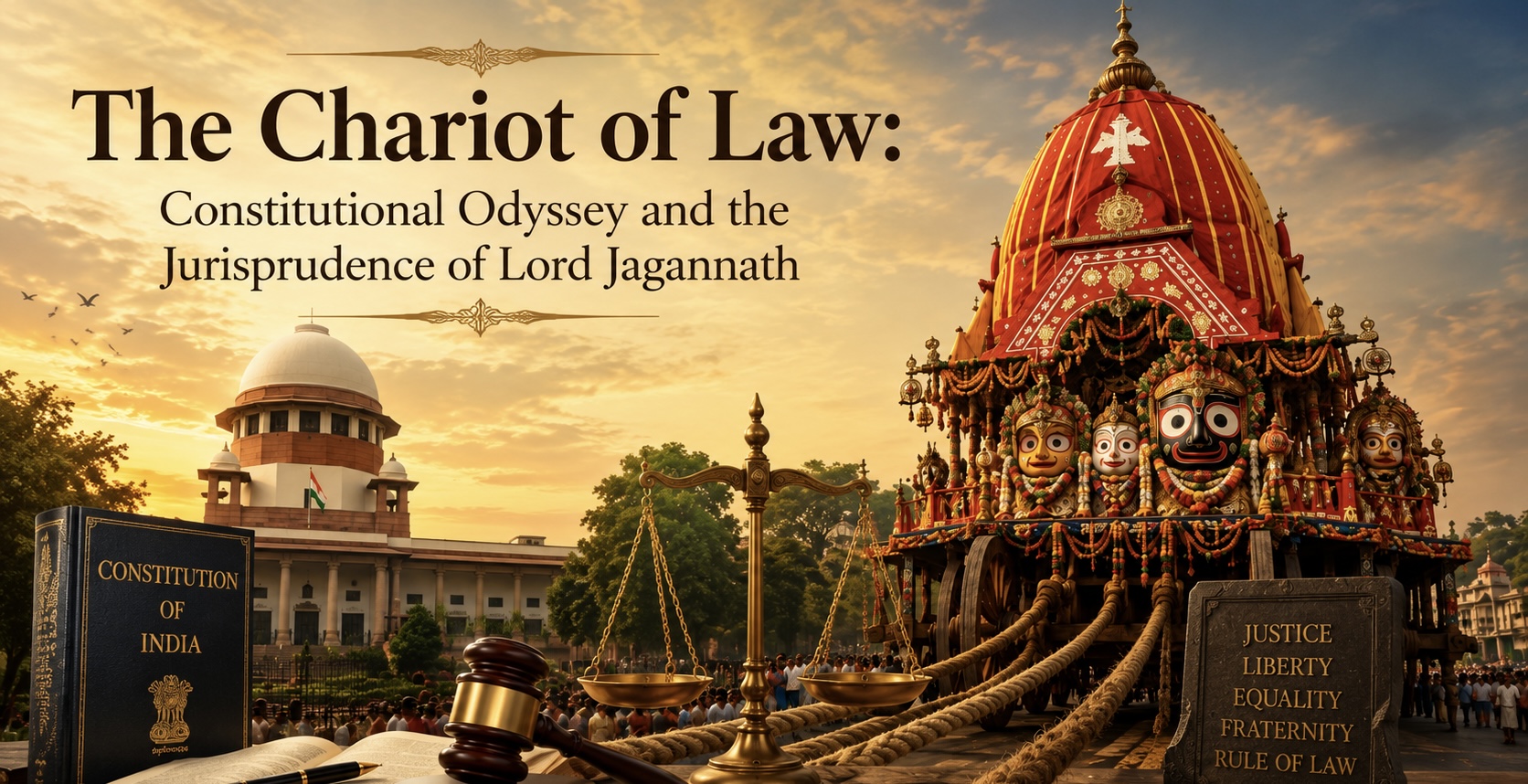
Every year, as the colossal chariots of Lord Jagannath, Lord Balabhadra and Devi Subhadra commence their majestic progress through the Bada Danda (Grand Road of Puri), millions witness an event that is at once spiritual, cultural and profoundly democratic. The Rath Yatra is not merely a festival, it is a constitutional metaphor in motion.
For a legal professional, the festival invites reflection beyond devotion. It compels us to ask an enduring question, i.e., how does the law engage with faith in a constitutional democracy?
The answer, unsurprisingly, lies not in choosing between religion and the Constitution, but in recognising that India’s constitutional architecture has evolved precisely to accommodate both.
The Deity Beyond the Sanctum
Perhaps the most remarkable aspect of the Rath Yatra is that the deity leaves the sanctum. In most religious traditions, divinity remains within sacred precincts. Lord Jagannath, however, reverses that convention. He comes out into the streets, not for an exclusive congregation but for humanity at large.
This movement from the sanctified enclosure to the public square mirrors one of the finest aspirations of constitutional governance. In a strikingly similar symbolic manner, institutions exist not to preserve privilege but to serve the people. Courts derive legitimacy not from ivory towers but from public confidence. Governments derive authority not from coercive power but from constitutional consent. Likewise, the Lord’s journey is not one of dominion but of accessibility. Justice, like Lord Jagannath, must never remain imprisoned within inaccessible institutions. It must travel towards the citizen.
The Great Leveller
Perhaps nowhere is Article 14 of the Constitution more vividly illustrated than before the chariot of Lord Jagannath. Kings, bureaucrats, judges, labourers, advocates, merchants and pilgrims all become indistinguishable participants in a shared act of devotion. No special enclosure alters the spiritual equality of those pulling the ropes. The Constitution describes equality as a legal principle. Rath Yatra transforms it into a lived experience. This is not equality through legislative drafting. It is equality through collective participation.
In an era increasingly characterised by social fragmentation, the festival reminds us that constitutional values flourish not merely in courtrooms but in cultural traditions that have, for centuries, emphasised shared humanity over inherited hierarchy.
The Rule of Law beneath the Spectacle
To the casual observer, the Rath Yatra appears as a spontaneous celebration. To those involved in its administration, it is among the most sophisticated exercises in public governance undertaken annually anywhere in the world. Months of preparation precede a single day. Judicial directions, administrative coordination, police deployment, disaster management, medical preparedness, traffic regulation, municipal planning, crowd control, environmental safeguards, and protection of heritage structures.
Each functions as a cog within an extraordinarily intricate constitutional machine. Law does not obstruct faith; law enables faith to flourish safely. The true genius of governance lies precisely here. The State neither performs the rituals nor dictates theology. It merely ensures that millions may exercise their freedoms peacefully, securely and with dignity.
The Boundaries that Preserve Freedom
One persistent misconception in constitutional discourse is that religious freedom excludes governmental regulation. The Constitution says otherwise. Articles 25 and 26 guarantee freedom of conscience and religious practice, yet expressly subject those freedoms to public order, morality and health.
This delicate balance becomes vividly apparent during the Rath Yatra. Traffic restrictions inconvenience thousands, commercial establishments are regulated, security checkpoints multiply, and movement is controlled. None of these measures diminish religious freedom. Rather, they make the meaningful exercise of it possible. Constitutional liberty has never implied constitutional anarchy. Rights flourish because law establishes the conditions necessary for their peaceful coexistence.
Lord Jagannath and India’s Constitutional Ethos
The word “secular” is often misunderstood as requiring the State to maintain indifference towards religion. Indian constitutionalism has never embraced such sterile neutrality. Instead, it follows what scholars frequently describe as principled engagement. The State may regulate. The State may facilitate. The State may preserve heritage. The State may intervene where constitutional values demand reform. What it may never do is establish religious supremacy.
The annual administrative involvement in the Rath Yatra therefore presents no constitutional contradiction. It exemplifies India’s distinctive model of secular governance, one that respects religion while remaining firmly anchored in constitutional limitations.
Faith Tested through the Litmus of Constitution
Few festivals have generated as rich a body of legal discourse as the Rath Yatra. Questions concerning crowd management, environmental protection, heritage conservation, public health, property rights and administrative accountability have repeatedly reached constitutional courts.
The unprecedented restrictions during the COVID-19 pandemic demonstrated the delicate equilibrium courts were called upon to maintain. Faith sought continuity. Public health demanded restraint. The judiciary was required neither to validate theology nor to diminish devotion, but to reconcile competing constitutional imperatives. It was an exercise not in religious adjudication but in constitutional balancing. That distinction defines mature judicial review.
The Invisible Constitution
One often imagines constitutional law as residing solely within statutes and reported judgments. Yet the Constitution truly comes alive in moments such as the Rath Yatra. It resides in the police officer patiently guiding pilgrims, in the sanitation worker ensuring public health, in the doctor attending emergencies, in the municipal employee clearing roads, in the judge hearing urgent petitions, in the advocate arguing questions of public law.
Constitutional governance is not confined to constitutional litigation. It manifests through countless public servants performing ordinary duties with extraordinary responsibility. The festival therefore becomes an annual reminder that institutions matter. The Constitution is not merely a document to be interpreted. It is a discipline to be practised.
We can also draw l strikingly similar such comparisons with other functions and ceremonies during the Rath Yatra.
The Chera Pahanra: The Majesty of Humility
Perhaps no ritual during the Rath Yatra has astonished observers more than Chhera Pahanra. The Gajapati Maharaja, once regarded as the sovereign ruler of Odisha, emerges not to command but to sweep the chariots with a golden broom.
The symbolism is revolutionary. The highest temporal authority performs what society has traditionally regarded as the humblest of tasks. The act proclaims that no office places its holder above service.
Modern constitutionalism embraces precisely this philosophy. Public office is not an instrument of privilege but a fiduciary trust. Every constitutional functionary, from the President to the village officer, holds power not as a personal entitlement but as a responsibility owed to the people.
The golden broom is therefore more than a ceremonial object. It is a constitutional reminder that leadership begins where ego ends.
Three Chariots: The Pluralism of the Procession
Lord Jagannath, Lord Balabhadra, and Devi Subhadra do not travel upon a single chariot. Each possesses a distinct vehicle, distinct colours, distinct dimensions, and distinct identity. Yet all three proceed together towards the same destination.
The Constitution, too, celebrates diversity without demanding uniformity. The Legislature, Executive, and Judiciary are separate institutions with distinct functions and powers. Federal units retain their own constitutional identities. Citizens profess different faiths, speak different languages, and cherish different traditions.
Constitutional unity has never required constitutional sameness. The three chariots teach that institutions may differ in form while remaining united in purpose. Diversity is not an obstacle to harmony; properly understood, it is its very foundation.
Rope of the Chariot: The Invisible Thread of the Republic
Perhaps the most powerful image of the Rath Yatra is not the towering chariot but the rope. No single devotee, however strong, can move the chariot. It advances only because thousands pull together.
The Constitution rests upon an identical premise. Judges alone cannot secure justice. Legislatures alone cannot protect democracy. Governments alone cannot preserve liberty. Citizens alone cannot uphold constitutional morality. Each has a hand upon the constitutional rope.
When all pull in the same direction, with fidelity to justice, liberty, equality, and fraternity, the Republic moves forward. When some pull backward while others refuse to pull at all, even the noblest constitutional aspirations remain stationary.
Perhaps that is the deepest lesson of the Rath Yatra. Neither the Lord’s chariot nor the constitutional project is carried by miracles. Both move because ordinary people collectively undertake an extraordinary responsibility.
Hera Panchami: The Accountability of the Divine
Five days after the Lord departs for the Gundicha Temple, Goddess Mahalakshmi sets out in search of Him. Finding that He has left without her, she expresses her displeasure not through confrontation but through symbolism, damaging a part of the Lord’s chariot before returning to the temple.
At first glance, the ritual appears domestic, almost playful. Yet beneath its surface lies a profound lesson in constitutional governance: no authority, however exalted, is immune from accountability. Even the Lord, in His role as sovereign, is gently reminded that power cannot be exercised in splendid isolation. Decisions, however well-intentioned, invariably affect others, and those affected possess both the right and the agency to register their dissent.
Constitutional democracies institutionalise this very principle. Judicial review checks executive action. Parliamentary scrutiny tempers administrative discretion. Fundamental rights restrain legislative excess. None of these institutions seek to diminish authority; they preserve its legitimacy by ensuring that power remains answerable. Hera Panchami, therefore, is not merely a divine marital episode. It is an enduring reminder that accountability is not an affront to authority but its indispensable companion.
Bahuda Yatra: The Circle of Constitutional Duty
The outward journey to the Gundicha Temple captures the imagination, but the return journey, the Bahuda Yatra, is equally significant. A journey that never returns is incomplete.
This mirrors an essential principle of constitutional adjudication. Justice is not fulfilled merely by delivering judgments from elevated benches. Its true measure lies in whether those judgments return to society in the form of meaningful change. A landmark decision that remains confined to law reports is much like a pilgrimage without a homecoming.
The Constitution is not written for courtrooms alone; it is written for streets, schools, workplaces, prisons, and homes. Rights attain significance only when they travel back into the everyday lives of citizens. Like the Bahuda Yatra, justice must complete its circle by returning to the people from whom it ultimately derives its legitimacy.
Suna Besha: The Majesty of Restraint
On the day following the Bahuda Yatra, Lord Jagannath appears in the resplendent Suna Besha, adorned with exquisite ornaments of gold. The spectacle is breathtaking, yet it is strikingly transient. The ornaments are removed soon thereafter, and the Lord resumes His familiar, unembellished form.
Therein lies an elegant constitutional lesson: the authority of constitutional institutions is often accompanied by immense ceremonial dignity. Judges wear robes. Courts command solemnity. The President resides in magnificent halls. Yet these symbols do not constitute the source of their authority. Their legitimacy flows from the Constitution, not from ornamentation.
The Suna Besha reminds us that dignity and grandeur have their place, but they must never eclipse humility. The finest judges are remembered not for the splendour of their office but for the wisdom of their judgments. The greatest institutions endure not because they appear majestic, but because they remain faithful to the constitutional values they embody. Gold may adorn authority, but it cannot define it.
Adhara Pana: Justice Beyond the Visible
As the Rath Yatra approaches its conclusion, one of its most poignant rituals unfolds in relative quietude. Enormous earthen vessels filled with Adhara Pana, a sweet, nourishing drink, are offered not to the assembled devotees but to the countless unseen spirits believed to have accompanied the divine procession. After the offering, the pots are deliberately broken, allowing the sacred drink to flow freely as nourishment for those invisible souls before they depart in peace.
Whether one perceives this ritual through the lens of faith or symbolism, its moral imagination is extraordinary. It reminds us that justice, too, cannot concern itself solely with those who stand visibly before the court. A truly just legal order must remain conscious of those whose voices are unheard, whose suffering goes unrecorded, and whose rights remain unasserted. The Constitution does not exist merely for the articulate litigant; it also protects the forgotten prisoner awaiting trial, the impoverished labourer denied dignity, the child without representation, and the victim who never reaches the courtroom.
Like Adhara Pana, justice must occasionally extend beyond the immediately visible. It must acknowledge that not every wound is pleaded, not every grievance is documented, and not every injustice arrives wrapped in a neatly drafted petition. The noblest courts have often exercised their jurisdiction not merely to resolve disputes but to recognise invisible suffering and restore invisible dignity.
Perhaps that is the enduring genius of Jagannath’s compassion. Even at the culmination of His public journey, His concern extends beyond the jubilant multitude to those whom others cannot see. The law would do well to emulate that vision. For the highest form of justice is not merely that which decides between competing claims, but that which remembers those who have no claim powerful enough to be heard. It is in that quiet act of remembrance that both divinity and constitutional morality reveal their finest expression.
Niladri Bije: Where Rajadharma Meets Grihastha Dharma
Among the most profound yet understated lessons of the Rath Yatra lies not in the grandeur of the chariots, but in the quiet philosophy of duty that culminates in Niladri Bije. Lord Jagannath’s departure from the sanctum is not an abandonment of Goddess Mahalakshmi; it is an affirmation of Rajadharma, the sovereign’s obligation to step beyond the confines of the palace and belong to the people. The Lord leaves the comfort of the temple because the duties of a ruler cannot be discharged from behind closed doors. Governance, like justice, demands presence, accessibility, and engagement with those whom one serves.
Yet, the journey finds its true philosophical completion only with the Lord’s return. During Niladri Bije, Goddess Mahalakshmi, aggrieved by His unannounced departure, symbolically refuses his entry into the temple. The image is at once intimate and profound: even the Lord must pause before the threshold of His own abode until harmony is restored. The offering of the beloved Rasagola is far more than a conciliatory sweet; it is the restoration of equilibrium between Rajadharma and Grihastha Dharma. It acknowledges that public duty, however noble, cannot permanently eclipse personal responsibility. The finest ruler is not one who chooses the State over the family, or the family over the State, but one who accords each its rightful place.
The legal profession encounters this delicate balance every day. A judge must subordinate personal predilections to constitutional morality, yet never lose the humanity that gives justice its soul. An advocate owes an unwavering duty to the client while remaining an officer of the court, bound by candour and ethical restraint. Every public servant, every constitutional functionary, lives within the tension between institutional obligation and personal relationships. Niladri Bije teaches that these duties are not adversaries but complements. Leadership is not defined by the sacrifice of one obligation at the altar of another; it is ennobled by the wisdom to harmonise them.
Perhaps that is the enduring jurisprudence of Niladri Bije. The chariot’s journey may symbolise the call of public service, but its homecoming reminds us that no constitutional order can flourish if duty is divorced from compassion. For justice, much like Lord Jagannath Himself, must always find its way back, not only to the institutions it serves, but also to the human relationships that give those institutions their meaning.
The Chariot Continues to Move: The Inexorable March of Justice
Lord Jagannath’s chariot moves only when thousands pull together. No individual, however powerful, can move it alone. The metaphor for constitutional democracy is irresistible. The judiciary protects rights. The legislature enacts laws. The executive administers governance. The legal profession safeguards accountability. Citizens uphold civic responsibility. Each contributes a hand to the constitutional rope. Should any one institution abandon its duty, the journey falters. Should all act in harmony, constitutional democracy advances.
The chariot therefore teaches a lesson far beyond religion. It reminds us that progress is always collective. Justice, like the Rath Yatra, is ultimately a shared enterprise.
As Odisha celebrates the timeless magnificence of the Rath Yatra, lawyers may discover within its ancient traditions an unexpectedly modern constitutional philosophy. Faith and law are often portrayed as adversaries. The Rath Yatra demonstrates that they need not be. One offers spiritual order. The other offers constitutional order. Both seek, in their highest form, human dignity. Perhaps that explains why the spectacle continues to inspire not only devotees but also jurists.
For every year, as the wheels of Nandighosha begin to turn, they quietly remind us that while societies evolve, the journey towards justice, equality and constitutional morality must never cease. Like the Lord’s chariot itself, the law must always remain in motion, accessible, accountable and guided by the collective strength of the people.
To the colonial imagination, Lord Jagannath was more than a deity; He was an enigma that defied comprehension. The annual Rath Yatra, with its immense chariots advancing through an ocean of humanity, left many early European observers awestruck. Unable to fully grasp the profound spiritual symbolism of the festival, British writers often portrayed the procession as an irresistible and overwhelming force. It is from this very encounter that the English language inherited the word “juggernaut,” a linguistic descendant of Jagannath. Modern dictionaries define a juggernaut as an inexorable, overwhelming force that crushes every obstacle in its path, a meaning that, though born of colonial misunderstanding and embellished by exaggerated accounts, nonetheless reflects the sheer magnitude and momentum that the Rath Yatra projected upon the Western mind.
Yet, if there is a juggernaut worthy of emulation in a constitutional democracy, it is not one of conquest but of justice. The chariot of justice, like the chariot of Lord Jagannath, must possess an irresistible moral momentum, unyielding before power, indifferent to privilege, and relentless in its pursuit of truth. It must not be arrested by political expediency, social prejudice, or institutional inertia. Just as countless hands unite to pull the Lord’s chariot towards its sacred destination, the advancement of justice demands the collective commitment of judges, advocates, lawmakers, administrators, and citizens alike. The true juggernaut of a republic is therefore not the crushing force imagined by colonial observers, but the unstoppable march of the Rule of Law, steadfast, impartial, and ultimately answerable only to the Constitution.
Jay Jay Jagannath, Jay Jay Jagannath, Jay Jay Jagannath.