In the Indian landscape, a society that is shaped by patriarchy, violence against women has always been a concern. A nation that takes great pride in cultural heritage and traditional roots, the misogynistic structure of the society largely contributes to gender disparities, leading to subsequent violence against women. With the passage of time and with the rising number of conversations around women’s safety and independence, the Legislature and the Judiciary have time and again made efforts to incorporate provisions within the code of criminal laws prevalent during the time to curb any further injustice against women. Even so, according to the reports of the National Crime Report Bureau, the number of reported crimes against women in 2011 and 2022 were 228,650 and 445,256, respectively, showing a significant growth that raises concerns as to the efficiency of the laws in place to protect the women.
The 2012 Delhi gang rape and murder case forced the nation to question whether the criminal laws were efficient enough to protect women. In 2013, several amendments to the Indian Penal Code, Indian Evidence Act, and Code for Criminal Procedure were passed. This should, in theory, result in a decrease in the number of crimes against women; however, the numbers have doubled within a span of 10 years, consequently increasing the number of backlogs in the courts and pending investigations.
Following cathartic amendments in 2013 and 2019, in what can be described as the biggest reforms in criminal law since independence, the introduction of Bharatiya Nyaya Sanhita, Bharatiya Nagarik Suraksha Sanhita, and Bharatiya Sakshya Adhiniyam replaced the outdated codes of criminal law established by the British in India, effectively from 1 July 2024. The objective was clear, i.e., to make the laws simple, promote efficiency and accountability, and adapt them to keep up with the dynamic state of contemporary society. Additionally, the Ministry of Home Affairs, via a press release dated 11 March 2025, issued a statement that crimes against women and children shall take precedence. Stricter punishments and speedy investigation and trial procedures have been established to achieve the same.
Enhanced Legal Provisions for Women in BNS
In a first, offences against women and children, which were previously scattered throughout the Indian Penal Code, have been amended and consolidated under Chapter V of the Bharatiya Nyaya Sanhita, which also has precedence over other offences. Chapter V ranges from section 63 to 99, out of which sections 63 to 92 deal with offences specifically against women. In addition to the offences mentioned in the IPC, the BNS introduces a new offence under section 69, which provides for the offence of having sexual intercourse, which does not amount to rape, by deceitful means or by promising to marry the woman without any intention. The implementation addresses serious concerns of manipulation of humans in order to get consent by using deceitful methods, such as false promises of marriage, employment, or promotion, thus creating an imbalanced power dynamic whereby a man controls the free will and consent of a woman.
In addition to merging the sections to make the provisions concise, a few of the provisions that provided for punishment also have been enhanced. For instance, section 70 of the BNS provides for gang rape, wherein the punishment has been enhanced from life imprisonment to death penalty for the offence of gang rape on women under the age of 18 years. The concept of gender neutrality in legal provisions has also somehow enhanced protection of women against crimes such as assault or use of criminal force against women with intent to disrobe under Section 76 and voyeurism under Section 77. Previously, under the IPC, cases against only male perpetrators could be filed.
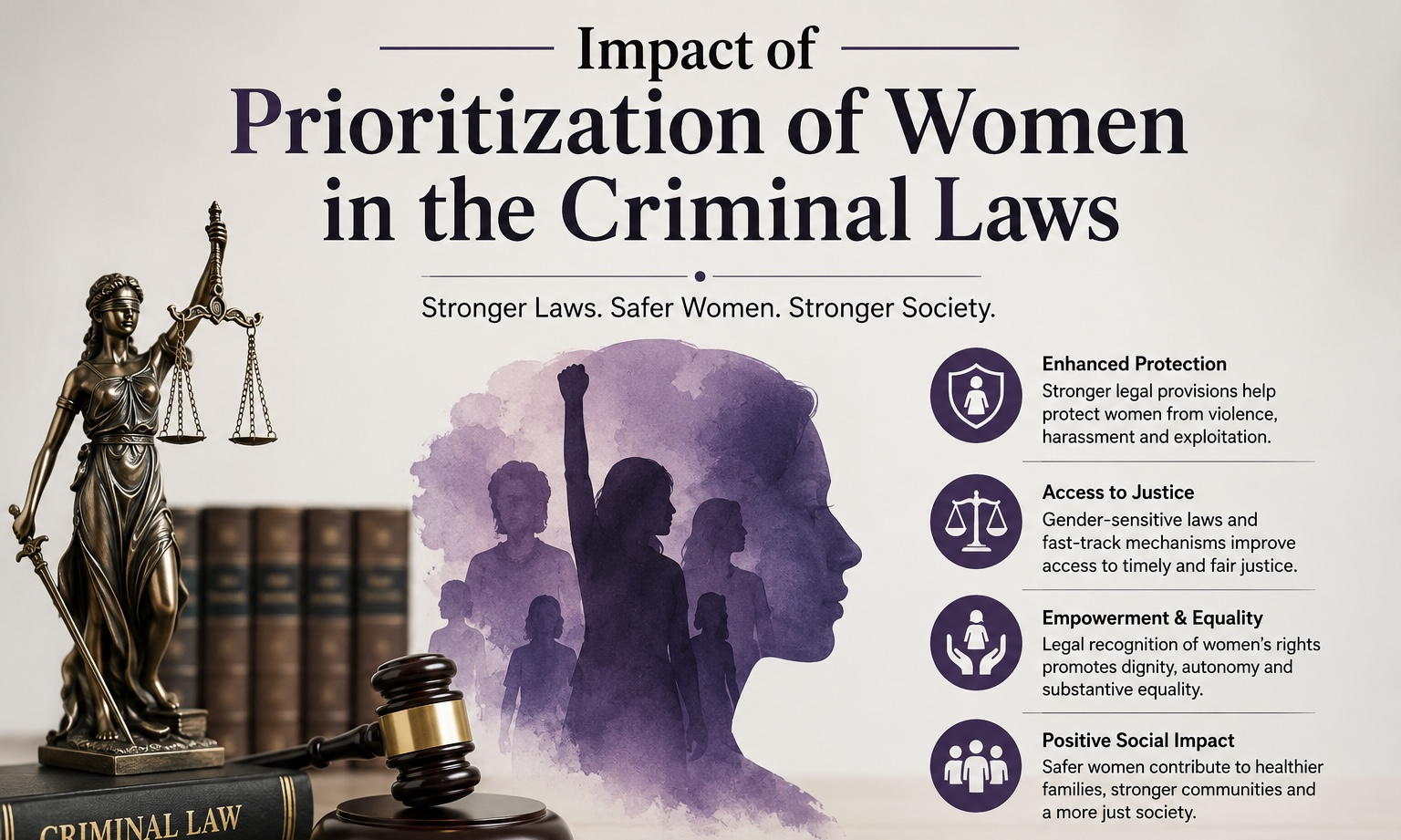
The punitive provisions of the criminal laws have been increased in order to deter offences against women. In addition to other specific legislation to protect women, the changes and additions have been brought to the BNS to broaden the purview of what can be included under the banner of offences against women. Increased penalties and punishments, along with certain enhanced punishments on account of repeat offences, discourage future misconduct and create a safer society for women.
Women-centric Procedural Changes
In an attempt to make the procedural part of the criminal justice system more gender sensitive, BNSS has implemented several checks. Previously, the Justice Verma committee report had dwelled upon the systematic gender bias in the processes. Gender bias within the criminal justice system is a major roadblock for prosecutors and police. The general approach by the police when the victim first approaches them is extremely crucial, as often times the victims do not report an offence due to prejudicial and improper responses by the police. The report has suggested that the method of investigation should be revisited and developed in order to safeguard a woman's interest. In light of the rising number of cases, prejudicial processes, and backlogs in the courts, through BNSS, the legislature has implemented several provisions in order to protect the victim and enhance the integrity of the investigation and trial processes.
For instance, to enhance the reliability of the victims of offences against women in the investigation process, several provisions call for the mandatory presence of women magistrates or women officers throughout the investigation process in order to create a comfortable environment for the victims that allows them to speak freely and lessen any trauma while recounting the incident. Along the same line, the Sanhita calls for putting sufficient distance between the victim and the accused in order to reduce the trauma that might be caused if the victim comes in contact with the accused. Further, digitalization provides for a safer and transparent process, enhancing accountability of the law enforcement officers and the judiciary. Several time checks have been provided throughout the BNSS with respect to the investigation and trial processes so as to efficiently handle evidence and conduct investigations and trials in a timely manner. The concept of Zero FIR has been formally introduced under section 173(1) to facilitate quicker reporting of offences, which are crucial to cases of various offences against women.
The success of the implementation of such time-bound checks can be witnessed in the Anna University sexual assault case. The assault was committed on 23rd December 2024, and through a quick probe, justice was served and punishment was pronounced on June 2, 2025. The chargesheet was filed within two months of the crime, and judgment was delivered within the next three months. Thus, if the provisions are properly adhered to and adequate resources and assistance are provided, speedy investigations and trials like this restore the faith of victims in the law.
Criticisms and Concerns
On the glorifying front, Chapter V of the BNS has been titled “Of Offences against Woman and Child.” While the title provides a sense of a renewed and ideal version of the legislation’s intent to empower the women by putting them first and above any other chapter or category of offences, the association of women and children in the title, on the surface, gives an exalted position to women and children and at the same time denies them independent identities within their own spheres. This, to the eyes of the radical feminists, relegates the position projected by the legislature for women to a vulnerable class of people in dire need of protection. This contradicts the Justice Verma Committee report that recommended understanding women's social identities as equal in character. Furthermore, the regressive colonial provisions pertaining to marital rape are still retained in the BNS under section 63, Exception 2, and section 67. These provisions reinforce the notion that a woman's body is owned by her husband, which causes severe deprivation to women of their right to their own person. These provisions are also in conflict with the recommendation by Justice Verma Committee that called for repeal of the marital rape exception.
While the provisions have been implemented to safeguard women's rights, in order to achieve it, several of these provisions continue to be gender specific, i.e., assuming women as the victims and men as the offenders. Stringent implementation of these provisions often leads to misuse of the law and the process whereby men are wrongfully accused and have barely any remedy for male victims. Where women are protected from offences of sexual harassment, rape, stalking, and domestic violence, among the offences, the legislation failed to acknowledge that men can be victims and women can be perpetrators in the same offences. Therefore, where a woman commits the same offence faces no legal consequences, and where a man is subjected to the same offence gets no legal remedy, it violates the fundamental right of equality enshrined under the Constitution. When there is inequilibrium in laws and laws overwhelmingly prosecute a particular category of people, in this case, men, suffer the impact of false accusations. While the numbers are marginalized, they definitely do exist. These motions are based on age-old stereotypes that portray men to be aggressive towards women. A primary example of such misuse of laws against men can be derived from false cruelty and domestic violence cases. Although judgments of the likes of Arnesh Kumar v. State of Bihar (2014) have been providing some relief against false accusations in cases of cruelty and domestic violence, harsh realities of cases of the likes of Atul Subhash force the nation to question the safeguarding of the rights of men in the same sphere. The BNS has thus drawn heavy criticism for unreasonably favoring women while letting go of the concept of gender justice. What is required is more balanced criminal legislation that protects every citizen and not just a particular gender.
BNS also fails to stand up and secure justice for the long-suffering transgender and queer community. By making the laws gender-specific and binary, i.e., recognizing only two genders: male and female, violence against the transgender and queer community has been ignored and silenced. The only time the term transgender has been mentioned is under section 2(10), which provides for the definition of ‘transgender.’ Ignoring how intersectionality plays a crucial role in contemporary society and its correlation with criminal law only adds to the long-suffered violence that the community has faced at the hands of family, society, and public servants. Even the Justice Verma Committee had recommended recognizing people from different sexually oriented communities and using gender-neutral terms to include members from the various communities and achieve social justice.
Way Forward
Laws must be amended to be gender neutral, recognizing that every individual can be a victim or a perpetrator of any offence. To prohibit misuse of the laws, strange punishments must be introduced against the filing of false cases. Gender sensitization programs must be made part of judicial training and training of law enforcement officials. To combat discrimination against marginalized communities, people within the justice system, including law enforcement, must be educated on intersectionality. This also ensures the reliability of such communities on the legal system. With the aim of overhauling outdated, colonial laws, the enactment of the three new criminal laws shows promising changes to several offences and procedural shortcomings by introducing a more victim-centric methodology and updating the laws as per the needs of the digital boom in the society. Women's safety has also been one of the priorities of the enactment. Despite the landmark amendments of 2013 and 2019, the rising number of crimes against women sparked the need for better, more efficient, and more accountable laws that form a more robust system to combat crime against women. While the broadening ambits of various offences, enhancements to stringent punishments, and provisions for timely completion of investigations and trials have been incorporated for efficient and speedy justice to women, one cannot turn a blind eye to the missed opportunity whereby the new laws that were supposed to be up-to-date with the needs of contemporary society failed to achieve gender justice. While the effort can be lauded for achieving justice for women, it barely does anything to protect men and other marginalized communities. Therefore, in addition to the protection of women, adequate laws must be implemented to make the provisions more gender neutral, holding any person who commits an offence liable and simultaneously allowing victims of any offence to approach the legal system, irrespective of their gender.